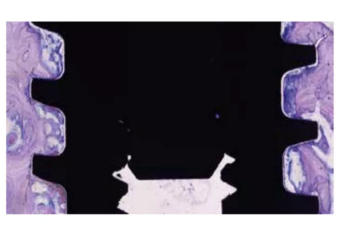
At 6 week the bone healing response to the SLA
surface is excellent and histology confirms new
bone ingrowth has occurred and is occupying
the space between the threads.
This type of rapid bone formation is essential
to the success of early loading and the
development of secondary fixation.
Faster and enhanced osseointegration is
developed through the maintenance of intimate
bone contact with the implant surface during the
early stages of integration.
At three weeks the pure SLA facilitates bone
contact with the implant surface following
insertion ensuring primary fixation.
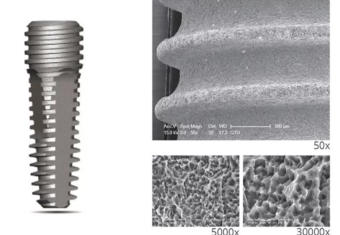
A SLA surface produced by sandblasting and
double etching process, produces an homogenous
rough surface with a 1.8 micron Ra. This type of
surface micro-texturing has been shown to
promote and stimulates early bone attachment to
the implant surface. Energy-dispersive X-ray
spectroscopy (EDXA) confirms that the implant
surface is free of biocontamination which can
result in poor bone to implant surface contact and
even failure to achieve osseointegration.
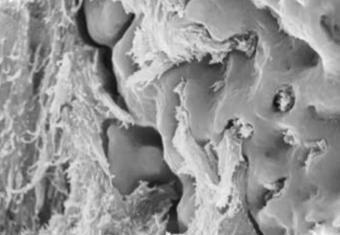
Electron microscopy shows intimate bone contact
and healing response to the SLA implant surface.
Implant Design Features and Philosophy
The implant system has been developed in
accordance with the six critical factors that
influence the process of osseointegration.
material biocompatibility
geometry of the implant
surface of the implant
implant host bone condition
surgical technique
loading conditions

Useful Information

Implant Design and Surface Features
SLA Surface Properties
2006-2025 nanodent Technologies. All rights
reserved.
Implant Design and Surface
Features
SLA Surface Properties
At 6 week the bone healing response to the SLA
surface is excellent and histology confirms new
bone ingrowth has occurred and is occupying
the space between the threads.
This type of rapid bone formation is essential
to the success of early loading and the
development of secondary fixation.
Faster and enhanced osseointegration is
developed through the maintenance of intimate
bone contact with the implant surface during the
early stages of integration.
At three weeks the pure SLA facilitates bone
contact with the implant surface following
insertion ensuring primary fixation.
A SLA surface produced by sandblasting and
double etching process, produces an
homogenous rough surface with a 1.8 micron Ra.
This type of surface micro-texturing has been
shown to promote and stimulates early bone
attachment to the implant surface. Energy-
dispersive X-ray spectroscopy (EDXA) confirms
that the implant surface is free of
biocontamination which can result in poor bone
to implant surface contact and even failure to
achieve osseointegration.
Implant Design Features and Philosophy
The implant system has been developed
in accordance with the six critical factors
that influence the process of
osseointegration.
material biocompatibility
geometry of the implant
surface of the implant
implant host bone condition
surgical technique
loading conditions
Electron microscopy shows intimate bone contact
and healing response to the SLA implant surface.
Useful Information
2006-2023 nanodent Technologies. All
rights reserved.
Get in Touch